The Early Signs of AI Governance Failure
June 25, 2026

Over the past few weeks, it has felt like every day brings another AI-related security story. Scroll through X/Twitter and you'll come across reports of newly discovered vulnerabilities, prompt injection attacks, exposed models, or discussions about how AI systems are being exploited in unexpected ways.
Security has quickly become a dominant theme in tech. Increasingly capable AI models are coming regardless of which company develops them or what restrictions are put in place, making governance a day-to-day operational concern.
In this third edition of Signal by AMPD Labs, we explore what happens when organizations adopt AI faster than their governance, policies, and compliance processes can support it.
These failures rarely begin with dramatic technical breakdowns. More often, they emerge through small gaps that build over time: One team assumes another already reviewed the system. An internal tool expands into production before oversight catches up. An integration becomes business-critical long before anyone formally recognizes it that way.
We think governance in AI tends to fail in these subtle, almost administrative ways long before the consequences become visible externally.
Gartner defines AI governance as the process of creating policies, assigning decision rights, and ensuring accountability around AI systems and investments. This frames governance as something deeply connected to an organization's culture and how they operate.
Many companies struggling with this today are technically strong and moving fast. The problem is that rapid adoption often exposes weak processes before leadership realizes how dependent teams have become on AI.
Over the past year, we've spoken with teams building AI tools at very different scales, from internal copilots to customer-facing systems. The pattern is usually the same. Early experimentation feels manageable because the systems are small, teams work closely together, and the risks still seem limited. Governance becomes something to address later, once the tools prove valuable enough.
Then adoption spreads faster than expected.
One workflow turns into five. Teams start testing different vendors on their own because everyone is trying to move quickly and avoid becoming a bottleneck. Departments are working with different assumptions about what has been approved, what data is being used, and who is responsible if something goes wrong.
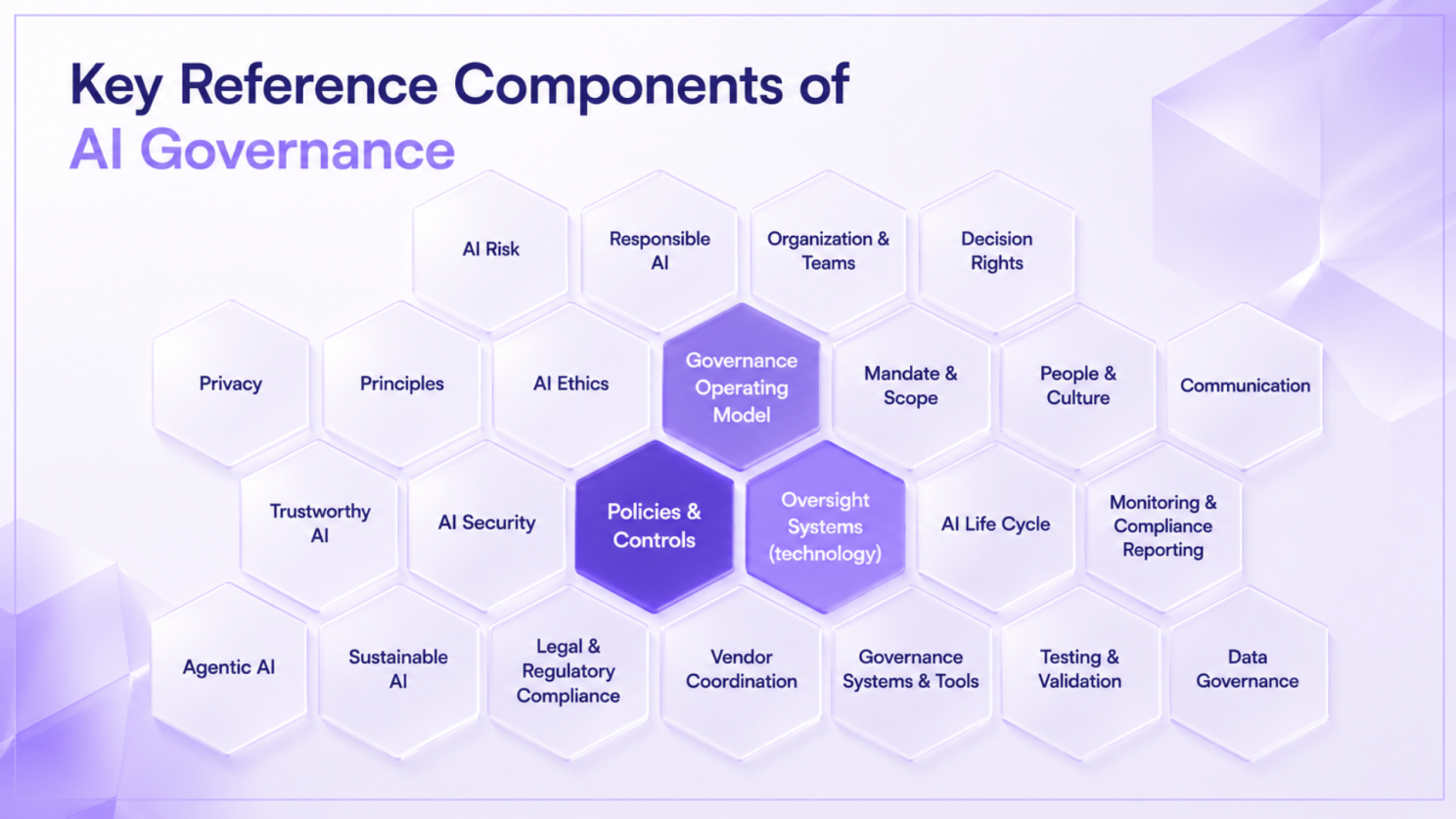
Early signs governance is breaking down
1. Ownership is unclear
One of the clearest warning signs appears when nobody knows who is responsible for what. You ask who approved something, and the answer changes depending on who you ask. Product assumes legal reviewed it. Legal thought security was handling the evaluation. Leadership approved the broader initiative but not the implementation details that emerged later once teams began adapting the tool internally.
Usually, nobody is acting irresponsibly. The issue is that unclear ownership becomes part of the system itself, and AI tools tend to amplify that confusion because they move faster than traditional software.
Our advice is to place strong emphasis on decision rights and accountability because governance weakens quickly once ownership becomes interpretive rather than explicit.
2. Governance only exists on paper
A surprising number of organizations already have AI principles written down somewhere. They often include thoughtful language around ethics, transparency, responsibility, and safe deployment. The problem is that governance documents can quietly drift away from day-to-day reality once teams begin working under actual delivery pressure.
You can usually see it happening when teams avoid governance processes unless they are required to follow them. Approvals get bypassed because they slow work down. Teams experiment through informal channels because official workflows no longer match the pace of implementation.
Our view is that governance needs to exist throughout the AI lifecycle rather than as isolated oversight documentation. That distinction matters because AI systems evolve too quickly for static governance models to remain useful for long.
3. Nobody monitors the system after launch
Many companies still treat deployment as the finish line, but governance becomes even more important after launch. AI systems change once they enter real environments. User behavior shifts. Teams grow dependent on outputs that once felt experimental. Models drift, and assumptions made during testing slowly shape larger decisions over time.
The problem is that these changes rarely happen all at once. They build gradually through routine use, which is why continuous monitoring matters.
We highlight ongoing compliance reporting and observability as core governance functions because unintended outcomes tend to compound quietly before organizations recognize the scale of the issue.
We've become increasingly interested in governance as a systems design challenge. In our experience, the companies handling AI well are rarely the ones making the loudest claims about innovation, but the ones that took the time to put the right processes, governance, and ways of working in place before AI became part of everyday operations.
They define ownership clearly, build approval processes people can realistically follow, and create shared language between technical and non-technical teams before fragmentation sets in. That approach strongly shapes how we think and work.
This matters even more in Web3 and emerging infrastructure environments, where experimentation often moves faster than traditional governance models can keep up with.
We highly recommend these two books:
- User Friendly by Cliff Kuang & Robert Fabricant explores how systems and interfaces shape human behavior, often in ways people barely notice. It is especially relevant to governance because strong systems are easier to understand, navigate, and use responsibly.
- Nudge by Richard H. Thaler & Cass R. Sunstein focuses on how environments influence decision-making. Its ideas feel increasingly relevant in AI, especially when thinking about automation, default behaviors, trust, and the way systems quietly shape organizational decisions over time.
Now the conversation is about observability, orchestration, validation layers, and operational monitoring. As autonomous systems become more connected, accountability becomes harder to trace across workflows and decisions.
More soon.